

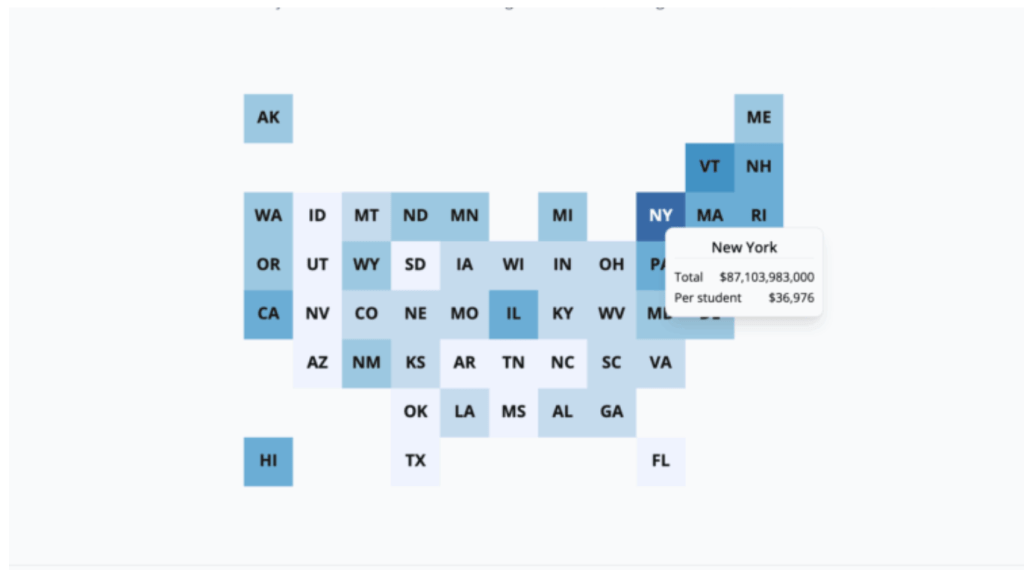
For the Per-Pupil Spending Chart: Smith, A. G., & Campbell, J. (2025, November 20). Table 1: K-12 public school funding per student in every state. Reason Foundation
A common assumption in American education finance is that the quality of students’ education is a direct result of the dollars invested in their school building. For decades, education advocates have argued that if schools were to reach a specific threshold of funding, then measures of student achievement like proficiency, graduation rates, and college readiness would naturally increase. This philosophy of increasing spending to improve student outcomes has governed New York’s educational policy for over twenty years, as the state is consistently leading the nation in per-pupil spending. As of the 2026 Executive Budget, New York State is projected to increase annual School Aid to a record $37.4 billion, which is a 4.7% increase from the previous year (NYS Division of the Budget, 2025). Despite this historically large investment in education, New York’s student outcomes in subjects like Grade 8 Math and Reading remain average, compared to other states around the country. I argue that in New York, the foundations of education finance have become inefficient as incremental dollar increases in spending are being swallowed by administrative bloat, legacy costs, and stagnant instructional models, which are all leading to stagnant student outcomes.
According to recent data from the Empire Center for Public Policy (2025), New York State school districts plan to spend an average of $35,012 per student for the 2025-26 school year. For context, this amount of spending is approximately 86% greater than the national average (Office of the NYS Comptroller, 2023). If this amount of spending resulted in the best student outcomes in the country, the amount of spending wouldn’t be critiqued. However, when comparing spending against the 2024 NAEP (National Assessment of Educational Progress) data, there is a significant lack of Return on Investment. Because Grade 8 represents nearly a decade of public investment in student outcomes should be a compounding interest effect that results in top scores around the country. Instead, the 2024 NAEP 8th-grade Reading score in NY (257) is statistically identical to the state’s score in 2003, and Grade 8 math shows similar stagnation (NCES, 2024). Stagnated student results despite increases in spending suggest that the $35,000+ per student per year is not actually being used to build a robust foundation or improve students’ math and reading performance.
A primary reason why New York’s education spending is inefficient is due to the expansion of non-instructional costs. According to the Citizens Budget Commission (CBC, 2025), New York spends significantly more per student on central and school-site administration than almost any other state. Additionally, in 2025, it was revealed that over ninety educators outside of New York City received more than $300,000 in annual pay. If New York is spending the most dollars on education, the administrative pay is a large reason why, and this is termed as Administrative Bloat. New York currently has a plethora of directors and specialists who exist outside the classroom and are taking a significant percentage of the $35,000+ dollars allocated per student.
New York’s education spending is also artificially inflated by non-productive dollars, which include pensions and healthcare benefits for retired employees. Due to decades of powerful labor negotiations, a significant portion of the current per-pupil expenditure is paying for the past educators instead of present students. These costs are a reason why New York’s spending looks so high on paper, while teachers in the classroom often feel under-resourced or underpaid. In many NY districts, fringe benefit costs account for nearly 30 cents of every dollar spent (Empire Center, 2024). While pensions and healthcare are necessary legal obligations made to former educators, from an efficiency standpoint, this funding has become dead weight to the current generation of students. For example, dollar spent on a pension for a teacher who retired in 1995 has zero impact on the Grade 8 literacy rate of a student in 2026.
There is another issue with how New York structures its education budget. Due to the Hold Harmless provision, no school district receives less Foundation Aid than it did the previous year, regardless of enrollment trends. While the purpose is to maintain stability in funding for schools, the issue in implementation is that between 2013 and 2023, public school enrollment in New York fell by 7.7%. And yet, the FY 2026 budget proposes a $1.5 billion increase in Foundation Aid (NYS Division of the Budget, 2025). Instead of consolidating to meet demographic reality, New York is effectively subsidizing infrastructure at the expense of student outcomes. Currently, money is being lost by maintaining half-empty buildings and redundant staff rather than being put toward instructional developments and student support.
While New York continues to increase its education spending, states like Massachusetts and Florida have used systemic efficiency to gain similar or better outcomes for students. Massachusetts and New York are both high-cost-of-living states that have a shared commitment to public infrastructure. However, despite these similarities, Massachusetts spends approximately $10,000 less per student than New York, according to recent NCES snapshots (2024). While New York leads the nation in spending, Massachusetts leads the nation in performance, consistently securing the #1 or #2 spot on the National Assessment of Educational Progress for Grade 8 Reading and Math.
The difference between New York and Massachusetts is that Massachusetts passed the 1993 Education Reform Act, which increased funding, but this funding was tied to the Massachusetts Comprehensive Assessment System. This assessment forced a uniform level of academic rigor across all zip codes and ensured that schools and districts were focused on performance to attain funding. Therefore, it is possible for a high-cost state to achieve world-class results for $25,000 per student per year. On the other hand, Florida’s per-pupil expenditure is roughly $13,500, nearly one-third of New York’s expenditure. Yet Florida’s 4th and 8th-grade reading scores frequently outpace New York’s. Florida’s efficiency is driven by aggressive moves like forcing districts to reallocate resources toward early reading intervention or creating a school choice environment that creates competitive pressure among school systems. Because funding follows the student within this school choice environment, traditional districts were incentivized to streamline their central office costs to remain competitive, which prevents the accumulation of administrative bloat seen in New York.
By examining these two very different but effective approaches, New York’s $35,012-per-pupil investment appears to be a symptom of structural failure. I argue that any advocates who believe that more money is the solution for New York are ignoring the reality that other states are already achieving far more with far less. Money only matters when it is tethered to efficiency, accountability, and instructional rigor, which is not happening in New York. The $35,000+ of funding per student is being funneled to protect the administrative status quo, fund legacy costs, and maintain half-empty school buildings. For New York to close its achievement gaps and improve Grade 8 outcomes, it must find avenues for efficient, data-driven management of existing resources. As long as New York continues to spend more than its peers to achieve the same or lesser results, it is merely subsidizing an inefficient system.


Leave a Reply