

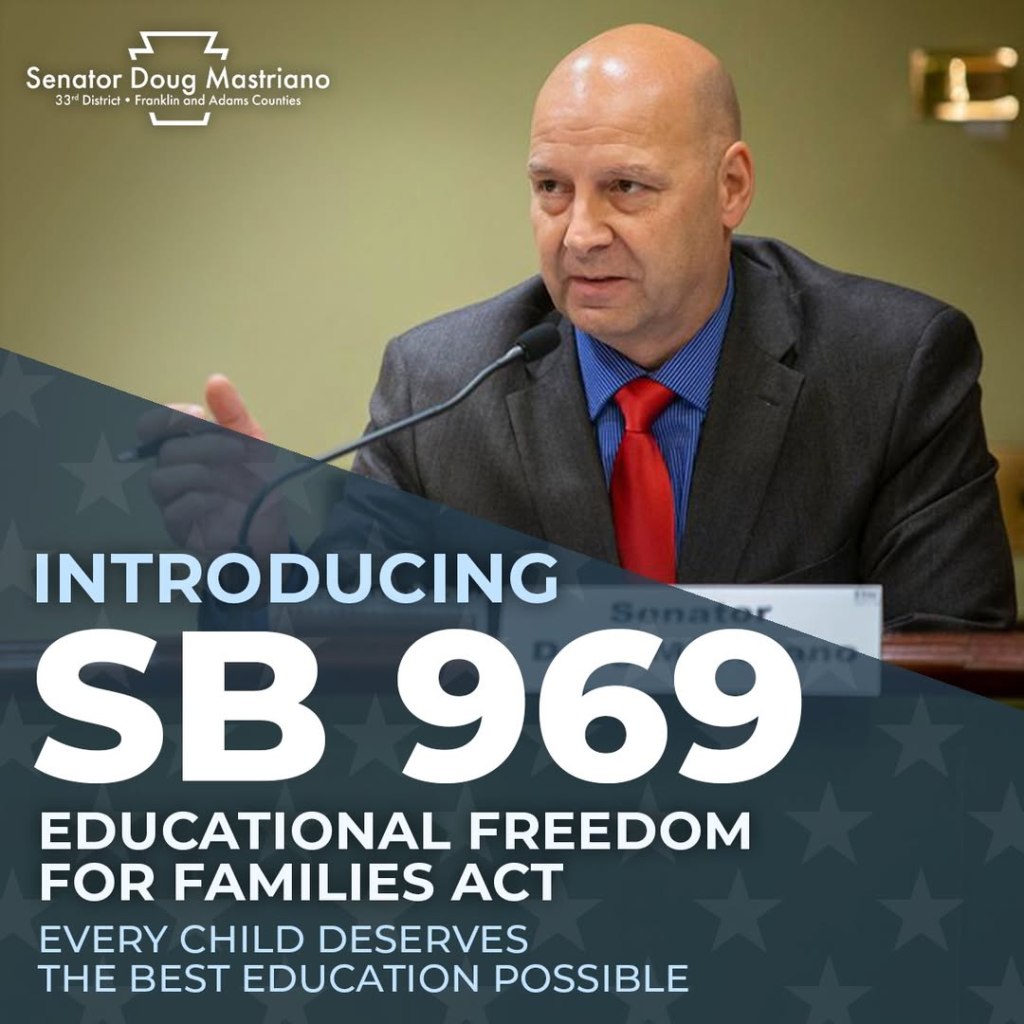
Source: Senator Doug Mastriano via facebook
Pennsylvania is currently facing a sustained decline in student academic performance, with recent data from the National Assessment of Educational Progress (NAEP) showing continued erosion in both mathematics and reading scores. At the same time, the state is maintaining a teacher compensation system that is disconnected from teaching effectiveness. If Pennsylvania is to improve its students’ performance in mathematics and reading, there needs to be a change in how teacher compensation is approached.
Pennsylvania’s SB 969, introduced on August 15th, 2025, has many subpolicies intertwined, with one aimed at creating the Teacher Excellence Incentive Fund (TEIF). This policy would include financial rewards, such as bonuses, salary supplements, and student loan forgiveness, as part of teacher compensation. These incentives would be provided if there is measurable progress in student outcomes. This policy brief supports adopting SB 969 because, if implemented effectively, it could improve teacher effectiveness, strengthen retention in high-need schools, and use public education spending to improve student outcomes.
The current state of NAEP performance in Pennsylvania
Student performance in Pennsylvania has been dropping in both math and reading over the past two decades. As shown in Figure 1, NAEP Grade 8 math scores rose from 2005 to 2013, then leveled off from 2015 to 2019, and dropped sharply after 2019. reaching about 272 by 2024 (NCES, 2025). Grade 8 Reading scores showed a similar pattern in Figure 2, as they peaked around 2013 and fell to about 258 in 2024. These results cannot be simply explained as learning loss due to the COVID-19 pandemic, as there has been a prolonged erosion in mathematics and literacy performance that predates the pandemic and has since accelerated.
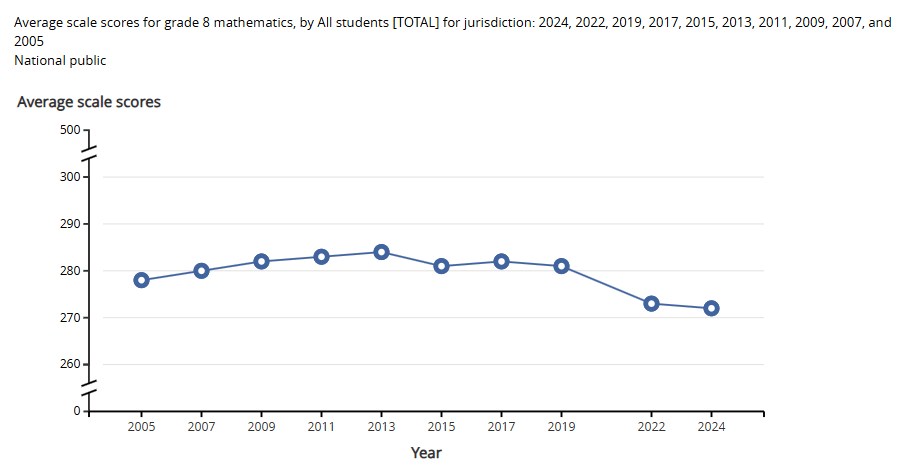
Figure 1. NAEP Grade 8 Mathematics Average Scale Scores, United States (2005–2024) Source: National Center for Education Statistics (NCES), NAEP 2024 Mathematics Assessment.
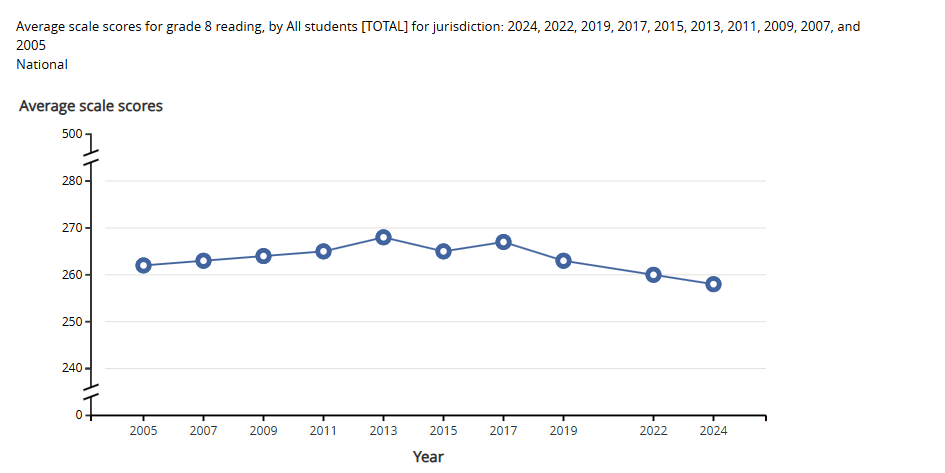
Figure 2. NAEP Grade 8 Reading Average Scale Scores, United States (2005–2024) Source: National Center for Education Statistics (NCES), NAEP 2024 Reading Assessment.
The above figures suggest that Pennsylvania is suffering from sustained weakening of instructional outcomes across its elementary and middle schools. With reductions in Grade 8 mathematics and reading performance, there are direct effects on high school course access, graduation readiness, and long-term participation in college and workforce pathways, particularly in STEM fields.
SB696 Explained
Despite these state-wide declines in performance, Pennsylvania continues to rely on a teacher compensation system that does not meaningfully differentiate between high-quality and low-quality instruction. Because most districts operate under step-and-lane salary schedules, where compensation is determined by years of experience and graduate credits rather than demonstrated effectiveness, teachers are not incentivized to improve their student outcomes. Any motivation to be an effective educator comes from personal teacher drive or school-wide expectations. Without policies to connect compensation to outcomes, the state has no leverage to improve the instructional quality of mathematics and reading at scale. SB 969 attempts to address this gap by introducing performance-based incentives tied to student outcomes.
SB 969 will establish the TEIF, which will be established in the State Treasury and funded annually by appropriations from various sources, including federal education reform funds. The State Department of Education will then use the money in the fund to provide salary supplements, bonuses, and/or student loan forgiveness. These bonuses would only be provided for improvements in SAT/ACT scores, year-over-year student growth, increases in the schoolwide average grade point average, or improved graduation or college admission rates. However, the annual eligibility criteria for incentives may change year over year, and data will be verified using standardized reporting protocols established by the department.
The Case for Using Incentives to Improve Outcomes
At its core, SB 969 addresses the fundamental policy problem that education systems currently do not incentivize what they expect to produce. Teacher compensation in the United States remains largely disconnected from instructional impact, despite extensive evidence that teacher quality is one of the most significant in-school factors affecting student achievement (Goldhaber, 2015). By linking compensation to student outcomes, SB 969 has introduced a mechanism to actually better aligns teacher pay with the pay standards within other professions. Across other professions, pay is tied to performance, like Key Performance Indicators (informally KPIs). KPIs have created clear expectations for employees’ effectiveness and performance and have aimed to increase the likelihood of sustained performance.
SB 969 differs from the structure of KPIs as it does not rely on a single measure of performance. By including multiple indicators, such as student growth, SATs, GPA, and graduation outcomes, this allows a more holistic evaluation of teaching effectiveness and reduces the risk of narrowing instruction to standardized test preparation alone. One immediate concern is that under this policy, effective educators would flock to high-performing schools to better increase their chances of reaching these KPIs. This would cause effective teachers ro be inequitably distributed across schools, leaving high-need schools serving low-income communities with greater difficulty attracting experienced educators. These schools are already experiencing issues with teacher retention and competitive pay. But the funding formula within SB 969 can introduce financial incentives that can help address these workforce imbalances. By increasing the scale of bonuses and student loan forgiveness if teachers meet the assigned goals within high-need schools, SB696 can encourage effective teachers to work in high-need schools. However, without addressing compensation, efforts to improve teacher distribution are unlikely to succeed, and while incentives alone are not sufficient, they are necessary to strengthen the teacher workforce.
Addressing the Effects of No Child Left Behind
Despite its potential benefits, SB 969 does raise legitimate concerns about over-reliance on standardized testing. Whenever teacher incentives are introduced at the state or district levels, educators are called back to the era of teacher accountability. In 2003, the No Child Left Behind (NCLB) Act introduced a high-stakes system heavily tied to standardized test performance in response to stagnating national reading and math performance. While NCLB did increase transparency of student outcomes and focused attention on achievement gaps, it also caused teachers to narrow their curriculum to teach to state tests and school-wide decisions by schools to game their results. After NCLB, federal education policy shifted under the Every Student Succeeds Act, which allowed states to incorporate growth measures and non-academic indicators as school effectiveness cannot be captured by test scores alone. Under SB 969, test scores are only one component of a broader set of measures aimed at prioritizing student growth over absolute performance, which actually benefits teachers working in high-need contexts.
Conclusion
Pennsylvania’s declining student outcomes demand a policy response that combats teacher ineffectiveness and aims to improve student outcomes across the state. If implemented with appropriate safeguards, I believe SB 969 will be an important step toward a more outcome-driven education system that recognizes and rewards effective teaching through its funding decisions. With this bill sitting in the Senate committee with no movement, the State Legislature is further delaying progress for its students. SB696 needs to be moved through the Education Committee and to the Senate floor within this session, or math and reading rates will continue to regress across the state.


Leave a Reply