

Over the past two decades, New York has made a sustained and costly commitment to public education. Per-student school spending has risen sharply, placing the state well above the national average and ahead of nearly every peer state. Yet during the same period, student math achievement, measured by the National Assessment of Educational Progress (NAEP), has steadily declined.
Viewed together, these trends underscore a central policy problem: increased education spending has not translated into improved math performance. The solution to New York’s math underperformance lies less in additional funding and more in how current resources are deployed.
Spending Has Increased Dramatically
Looking through recent reports, I found Figure 1 from The Citizens Budget Commission earlier this year. This figure shows the change in per-student school spending from 2006–07 to 2021–22 for New York and a group of peer states. As I analyzed this graph, New York’s spending level stands out as an outlier over the last 15 years. By 2021–22, New York spent substantially more per student than every comparison state and nearly double the national average. This gap is not marginal; it reflects tens of billions of dollars in additional annual spending relative to similarly sized states. For example, New York State has nearly 2.4 million students, compared with Florida, which has nearly 3 million. New York State is spending almost 90 billion dollars on education, compared to Florida, which is spending slightly over 30 billion dollars, according to both states’ fiscal budgets.
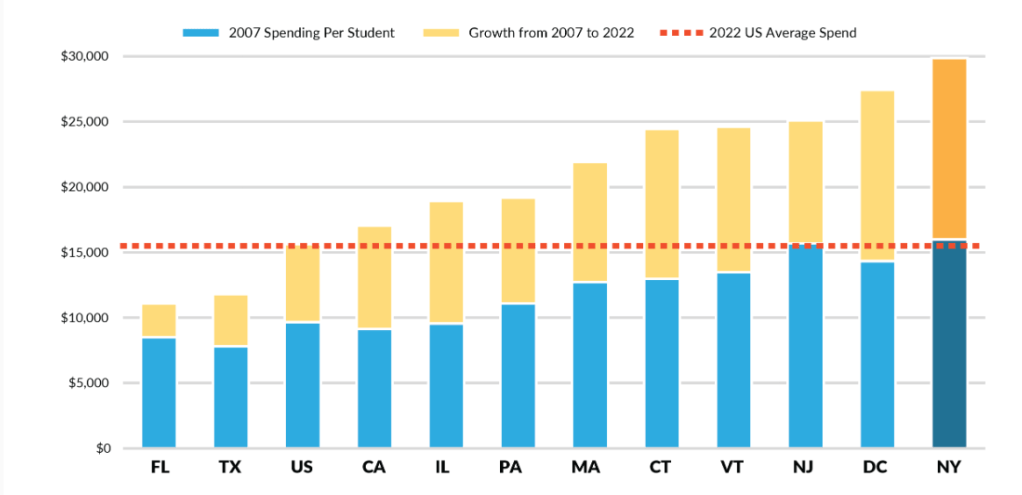
Figure 1. Change in school spending per student from 2006–07 to 2021–22, New York and peer states. Source: Citizens Budget Commission, Highest Costs, Middling Marks (2025).
This growth in spending reflects years of policy decisions at the state and local level, including changes to funding formulas, rising pension and benefit costs, expanded services, and post-pandemic federal aid. In raw fiscal terms, New York has demonstrated a clear willingness to invest in public education. Nonetheless, New York State has produced regressing Grade 8 Math Scores on the NAEP. Grade 8 Math scores are used to measure the health of the educational ecosystem as these results indicate how well prepared students were in elementary and middle school as well as is a predictor of high school achievement.
Grade 8 Math Performance Has Declined Despite Increased Spending
There has been a national trend of declining math performance since the COVID-19 Pandemic. This trend can be seen in Figure 4, across every state shown, math performance declined from 2007 to 2022. These years were chosen to directly relate to the spending data overviewed in Figure 3. New York’s average score fell from 280 to 271, closely tracking the national decline from 281 to 274. While New York does not appear as an outlier in performance, it does in spending, it is concerning that, despite far higher per-student investment, its math outcomes look remarkably ordinary.
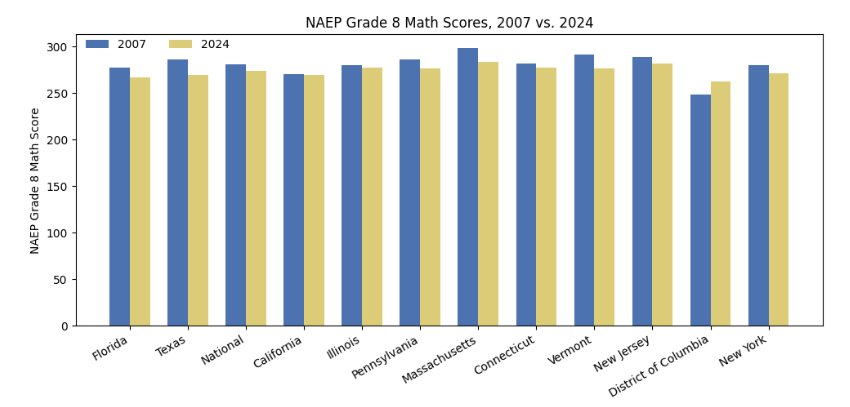
Figure 4. NAEP Grade 8 math scores in 2007 and 2024 for New York and peer states.
Source: National Center for Education Statistics, NAEP Data Explorer.
It is important to note that high-spending, historically high-performing states declined as well during this 15 year span. Massachusetts, New Jersey, and Vermont all experienced substantial drops in math achievement despite robust funding and strong institutional capacity. This indicates that New York’s experience is part of a broader national challenge, but its exceptionally high spending makes the lack of relative performance gains more striking.
Over the past decade, New York has layered multiple reforms onto the system with Common Core–aligned standards, repeated Regents exam revisions, expanded access to Algebra I, high-dosage tutoring initiatives, and curriculum investments funded largely through temporary federal dollars. These efforts were often well-intentioned and evidence-based in isolation. But NAEP outcomes indicate that they have not added up to sustained, system-wide improvement in math learning.
One explanation for the disparity between state investment and student performance is that increased spending has not consistently translated into stronger core instruction. New York remains a local-control state, meaning instructional quality varies widely across districts. Investments in tutoring and intervention have helped some students, but they cannot compensate at scale for uneven curriculum implementation, staffing instability, and persistent absenteeism. As the Elementary and Secondary School Emergency Relief Fund (ESSER), a federal funding program providing over $190 billion to K-12 schools through COVID-19 relief acts, expired, many of the most intensive math supports are already being scaled back. Additionally, persistent structural challenges remain despite the investment. Notably, chronic absenteeism, teacher staffing instability, and fragmented instructional systems have undermined recovery efforts and led to declining math performance since the COVID-19 Pandemic.
Next Steps
While New York has demonstrated the political capacity to increase education funding, but it has not yet demonstrated the system-level capacity to convert that spending into sustained improvements in math achievement. The NAEP results suggest that future reforms must move beyond incremental adjustments and access-oriented strategies. If New York is serious about reversing long-term math declines, policy efforts will need to focus more directly on:
- instructional coherence across districts,
- teacher capacity and curriculum implementation,
- sustained, evidence-aligned supports that outlast temporary funding streams.
Without these shifts, higher spending risks continuing to produce higher costs with middling academic results, a pattern the state can no longer afford to accept. Blindly throwing money at the problem of low academic performance will continue to send New York into a downward spiral of math performance. With a unified vision and overhaul of current measures, New York can begin moving toward positive performance.
 Advancing Equity With Policy
Leave a comment