

While public discourse often frames the teacher shortage as a post-pandemic crisis, two decades of empirical evidence tell a very different story. In short, New York has struggled to recruit, prepare, and retain qualified math teachers for more than twenty years.
This teacher shortage is the product of long-standing structural conditions, labor-market dynamics, and policy decisions that have weakened the math teacher pipeline over time. Therefore, when we cite a math teacher shortage as a cause of declining math performance, we are not referring to the emergence of a new crisis, but the culmination of one.
2006–2009: Early Warning Signs
By the mid-2000s, New York was already showing clear signs of stress in its math teacher workforce. NYSED’s retention and certification reports from this period flagged emerging shortages in mathematics, science, and other STEM fields as early as 2006, especially in high-poverty, rural, and urban districts, including New York City. As a result, many districts, particularly those serving vulnerable populations, began staffing math classrooms with uncertified or out-of-field teachers, a practice strongly associated with weaker student outcomes.
Additional NYSED data from 2007–2010 reinforce just how early the teacher pipeline began weakening. As shown in Figure 1, although more than 16,000 individuals completed teacher preparation programs each year, far fewer progressed to certification, and an even smaller share were ultimately hired into teaching roles. Between 2007 and 2010, the number of new teacher candidates hired by New York public and charter schools fell from 6,636 to just 3,446, a nearly 50% decline in only four years. This steep drop-off indicates that New York was failing to convert program graduates into classroom teachers more than a decade before post-pandemic teacher shortages, even though teachers were graduating from the teacher preparation programs.
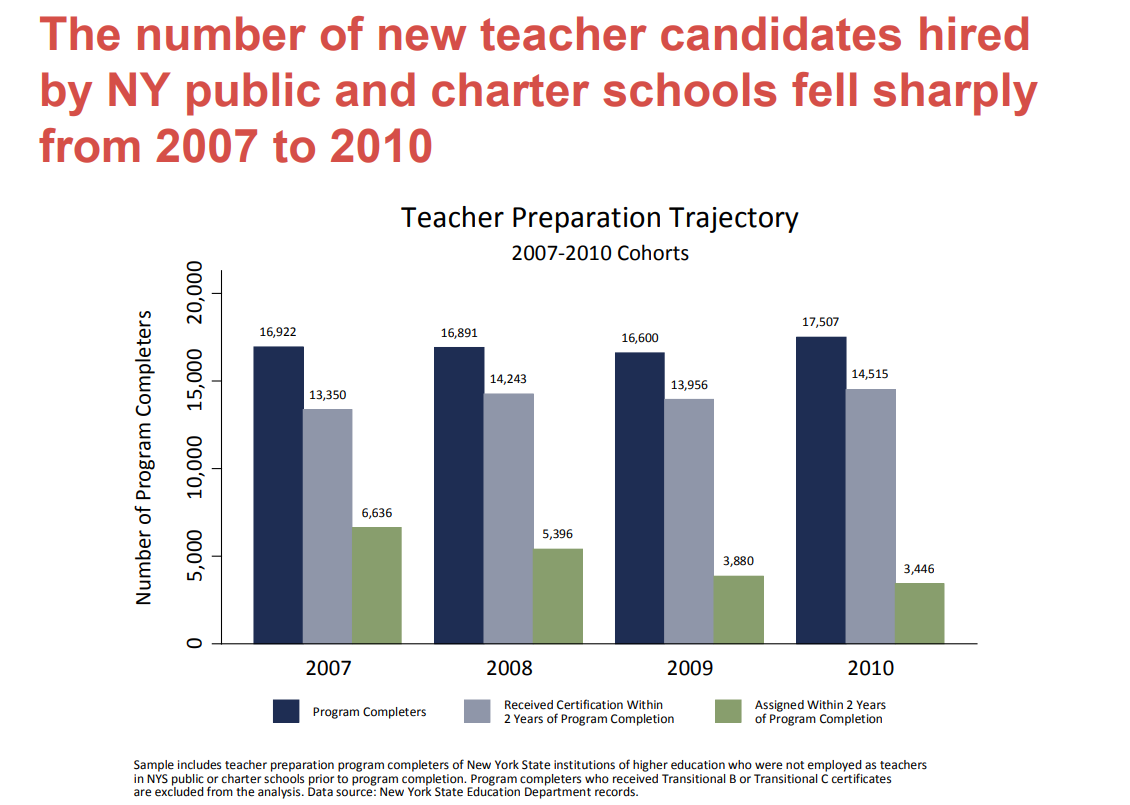
Figure 1. The number of new teacher candidates hired by NY public and charter schools fell sharply from 2007 to 2010. Source: New York State Education Department
During these three years, in which the number of teachers assigned to the classroom decreased by about 50%, the distribution of teacher certifications was causing another issue. Between 2007 and 2010, nearly 44% of all initial certifications were in elementary and early childhood education, while only 3% were in secondary mathematics. This meant New York was dramatically overproducing teachers in low-vacancy fields and underproducing in high-need subjects like math. In the same report, it was shown that only 26% of Elementary and Early Childhood teachers were hired within 2 years, while 49% of Mathematics teachers were hired within 2 years.

Figure 2. Distribution of initial certifications earned by program completers (2007–2010). Nearly half were in elementary education, while only 3% were in mathematics. Source: New York State Education Department (2010).
2010–2018: The Pipeline Shrinks Dramatically
The 2010s brought a more severe and measurable problem to the teacher workforce: the collapse of the teacher preparation pipeline. NYSED reports show a 47% decline in enrollment in teacher preparation programs between 2009 and 2020 (New York State Education Department, 2022). A report by the US Department of Education found that there was a 53% decline in Teacher Preparation programs in New York (Figure 3). The results of both of these reports showcase that fewer individuals entered teacher education programs, and even fewer specialized in mathematics or science. Math and special education were consistently classified as “hard-to-staff” fields throughout this entire decade.
National research helps explain why this happened. Darling-Hammond, Sutcher, and Carver-Thomas (2017) found that math shortages nationwide were driven by three intersecting factors:
- steep declines in enrollment in teacher preparation programs
- persistently high turnover, especially in high-poverty districts
- stronger wage competition for STEM graduates outside the teaching profession
By 2018, New York State was facing challenges producing well-balanced teacher education cohorts, placing certified teachers in schools, declining enrollment in teacher education programs, and retirements among tenured teachers.
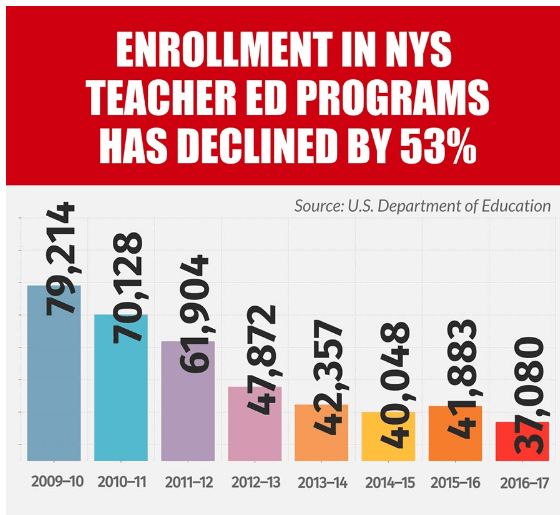
Figure 3. Enrollment in New York State teacher education programs declined by 53% between 2009–10 and 2016–17. Source: New York State United Teachers (n.d.), based on U.S. Department of Education data
2019–2024: The Shortage Becomes a Full-Blown Crisis
Based on the trends in New York State, the pandemic did not create the math teacher shortage; it exposed and accelerated it. NYSUT (2024) now estimates that New York will need 180,000 new teachers over the next decade to fill vacancies created by retirements, turnover, and declining output from preparation programs. NYSED’s statewide shortage analysis (2022) identified chronic vacancies in:
- mathematics
- bilingual education
- special education
- rural and high-need districts across every region of the state
To make matters worse, from 2020 to 2023, the nation was rocked by teacher turnover reaching its highest level in two decades. According to the Learning Policy Institute (2025), schools nationwide saw increases in math vacancies and underqualified teacher placements, especially in high-poverty communities, which are precisely the districts that already struggled to recruit and retain math teachers even before COVID-19. Based on Figure 4, the teacher supply across the nation is declining while the demand is projected to continue increasing. This mismatch of qualified teachers vs demand for teachers is one factor leading to stagnant or declining mathematics scores for students in New York and across the country.
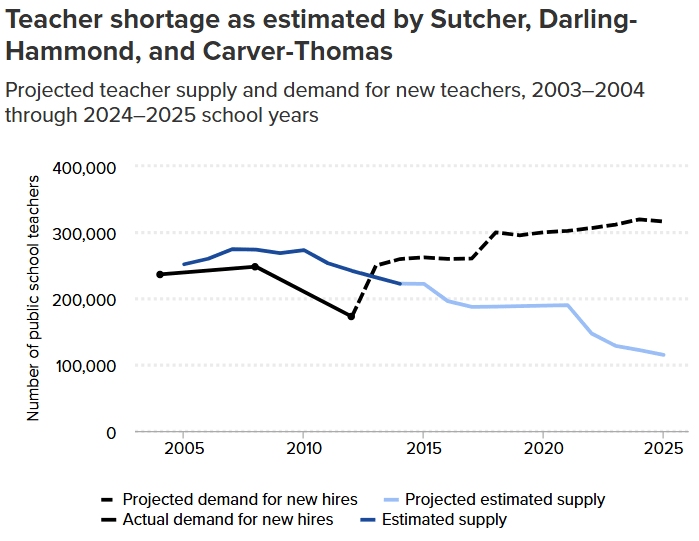
Figure 4: Projected teacher supply and demand in the United States from 2003–04 through 2024–25, showing growing shortages over time. Source: García, E., & Weiss, E. (2019), Economic Policy Institute.
Why This Matters: The Academic Impact of Staffing Instability
Math teacher shortages are directly affect student learning. Students taught by uncertified or out-of-field math teachers score significantly lower on standardized assessments (Ingersoll et al., 2021). Districts with the highest rates of uncertified hires often show the lowest NAEP performance, and those experiencing the greatest staffing instability consistently struggle to provide coherent, high-quality math instruction.
Staffing instability → instructional instability → lower student achievement.
This pattern is especially stark in districts serving economically disadvantaged students, where shortages are most severe and academic performance gaps are widest. As a state, we cannot advance equity for our students if we cannot provide quality educators to instruct ALL students. Thus, the first policy change New York State should make to improve math outcomes is to strengthen the Math Teacher Pipeline.
New York’s Math Teacher Shortage Is a 20-Year Structural Failure
I conclude that New York’s math teacher shortage is not a new trend, nor is it a pandemic-era anomaly. It is the predictable result of:
- long-term declines in preparation program enrollment
- high turnover and burnout in math-specific roles
- wage competition that disadvantages the teaching profession
- chronic inequities across districts
- underinvestment in sustained teacher workforce pipelines
New York cannot improve math achievement without addressing the structural roots of its math teacher shortage. I have previously highlighted that Grade 8 Math Scores on the NAEP have regressed about 10 points in the last 15 years and if New York continues on its current trajectory, there are no indicators of student outcomes improving.
However, I believe the teacher pipeline can be fixed. In my next blog post, I will evaluate New York’s efforts in increasing its pool of Math teachers as well as provide policy solutions to improve the Math Teacher Pipeline over the next few years.
 Advancing Equity With Policy
Leave a comment